Key Takeaways
- There are three main ways to store gold in the UK: at home in a safe, in a private safe deposit box, or in a professional vault, usually on an allocated basis.
- Home storage is cheapest but needs the right safe and insurance: a Eurograde 0 safe typically carries a £60,000 valuables rating, enough for about 19 oz of gold at the 3 October 2026 spot price.
- Vault storage costs a yearly fee: The Royal Mint charges 1% + VAT a year for coin tubes and larger bars, and 2% + VAT for single coins and 1 g to 10 g bars.
- Allocated is not the same as unallocated: allocated gold is held in your name, while unallocated gold makes you a creditor of the provider.
- High street banks have largely left the safe deposit box business, so most UK boxes are now offered by private companies.
- Handle gold as little as possible: The Royal Mint recommends cotton gloves, airtight capsules and keeping gold away from damp and tarnished metal.
You have bought your first physical gold: a few coins or a small bar. Now comes the question every new investor asks: where do I keep them? How to store gold is not just a security question. It affects your costs, your insurance, how quickly you can sell, and even the condition, and therefore the resale value, of your coins.
In this guide, we compare the main gold storage options in the UK: home safes, safe deposit boxes and professional vaults. You will see real safe ratings, storage fees, insurance points, handling rules and a checklist to help you choose. At the end, you will find a summary and an FAQ.
How to Store Gold: Your Three Main Options
Gold storage means keeping physical bullion safe from theft, loss and damage while still being able to reach it when you need to sell. In the UK, you have three realistic choices:
- At home: in a certified safe, fixed to the floor, with suitable insurance.
- In a safe deposit box: rented from a private safe deposit company, since most banks no longer offer them.
- In a professional vault: run by a mint, dealer or specialist custodian, where your gold is usually stored on an allocated basis.
Which one is best? It depends on how much gold you own, how often you want to touch it, and how much you are willing to pay each year. Many investors split their holdings: a few coins at home, the larger part in a vault.
| Feature | Home safe | Safe deposit box | Allocated vault |
|---|---|---|---|
| Yearly cost | One-off safe purchase, plus any extra insurance | Annual rental fee | Percentage of metal value (for example 1% + VAT at The Royal Mint) |
| Access | Any time | Opening hours only | Withdrawal or sale on request |
| Insurance | Your policy, check the limits | Often separate, check the terms | Usually included in the fee |
| Theft risk | Highest, depends on discretion and safe grade | Low | Low |
| Selling | You take the gold to a dealer or post it | You collect it first | Often sold back without moving the metal |
| Best for | Small holdings, people who want physical control | Medium holdings, privacy | Larger holdings, hands-off investors |
Storing Gold at Home
Storing gold at home gives you full control and no yearly storage fee. It also puts all the risk on you. Gold is small, valuable and easy to sell, which makes it attractive to burglars.
Is it safe to keep gold at home? Yes, it can be, if you buy a proper safe, keep quiet about it and insure it correctly. Without those three, it is the riskiest option.
Choosing a safe: cash and valuables ratings
UK safes are graded by insurers. The cash rating is the amount of cash an insurer will usually cover inside the safe. The valuables rating, for items like gold and jewellery, is typically ten times higher. The Royal Mint describes the cash rating as “the level of cover that an insurance underwriter will give to the cash contents of the safe.”
| Safe grade (Eurograde) | Cash rating | Valuables rating | Gold covered at spot |
|---|---|---|---|
| Grade 0 | £6,000 | £60,000 | about 19 oz |
| Grade 1 | £10,000 | £100,000 | about 32 oz |
| Grade 2 | £17,500 | £175,000 | about 56 oz |
| Grade 3 | £35,000 | £350,000 | about 112 oz |
| Grade 4 | £60,000 | £600,000 | about 191 oz |
What does that mean in practice? On 3 October 2026, a Grade 0 safe with a £60,000 valuables rating covered about 19 troy ounces of gold, or roughly 600 grams. Once your gold is worth more than that, you need a higher grade or a different solution.
Where to put the safe
A good safe in the wrong place is a weak safe. The Royal Mint’s guide to storing bullion recommends that you:
- bolt the safe to the floor so it is not freestanding,
- keep it locked away and out of sight,
- choose a dry spot, away from damp and anything corrosive,
- make sure it is big enough for the bullion you plan to add later.
Fire resistance is worth considering too. A fire-rated safe protects documents, certificates and assay cards, which matter when you sell bars.
Keep quiet about it
Discretion is free and it works. Do not tell people you own gold, do not post photos of your coins online, and think about the packaging that arrives at your door. Ask your dealer whether it ships in plain, unmarked packaging.
Police forces give the same advice. In February 2026, Avon and Somerset Police warned of a rise in thefts of high-value gold jewellery, cash and safes from homes:
“We urge residents to remain vigilant, report any suspicious activity, review home security arrangements and how high-value items are stored.”
Scott Hill, Chief Inspector and Force Burglary Lead, Avon and Somerset Police, warning on high-value gold thefts, February 2026
Home insurance and gold
Will your contents insurance pay out if your gold is stolen? Not always. The Royal Mint warns that “your contents insurance may not cover your bullion portfolio”. Many policies have a limit for valuables or for single items, and some exclude bullion entirely.
Before you store gold at home, check these points with your insurer:
- Is bullion covered at all, and under which heading?
- What is the limit for valuables and for a single item?
- Do they require a safe of a specific grade?
- Do you need to keep receipts or a list of serial numbers?
Remember that cover can fall behind the gold price. One troy ounce was worth £2,874 on 1 October 2025 and £3,136 on 3 October 2026, a rise of about 9%. On 1 March 2026, the highest of our monthly readings, it was £3,918. If you insured your holding a year ago, your sum insured may now be too low. You can follow the value on our gold price chart.
Read also: Why Buy Gold? 9 Reasons UK Investors Hold Physical Gold
Safe Deposit Boxes: Still an Option in the UK?
A safe deposit box is a locked box inside a vault that you rent and fill yourself. The provider does not usually know what is inside.
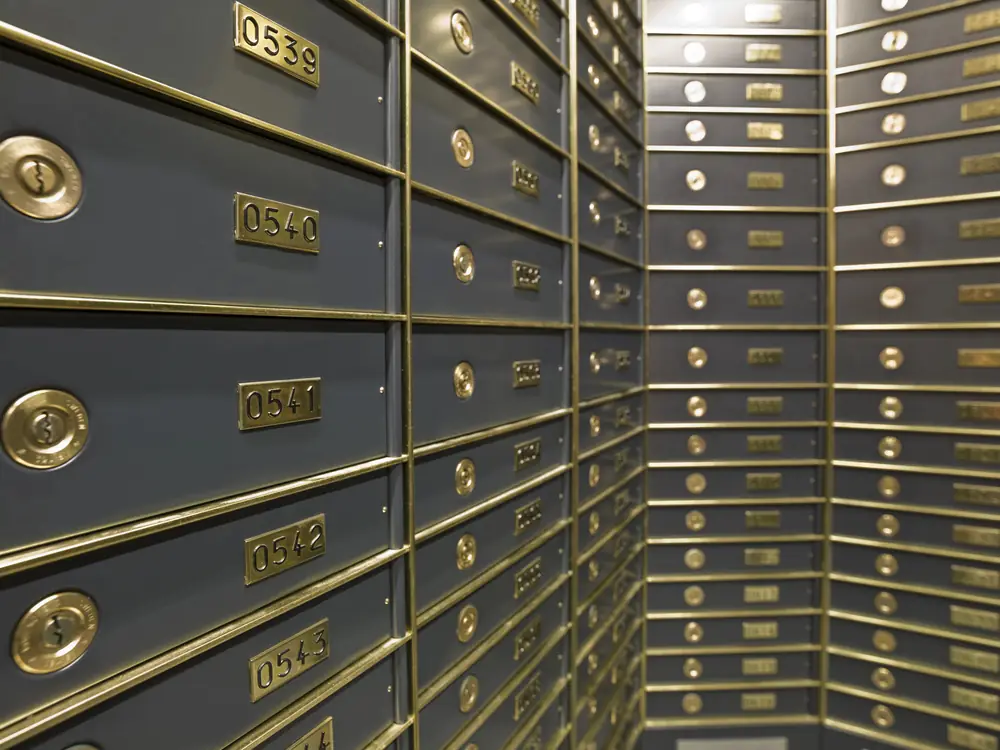
Can you still get one at your bank? Usually not. Most big UK high street banks have stopped offering safe deposit boxes to new customers over the past 15 years, and some have closed the service completely. Today, most boxes are offered by private safe deposit companies, mainly in larger cities.
Pros and cons of a safe deposit box
Choose a safe deposit box if:
- you want your gold out of the house but still under your own key,
- you want privacy about what you store,
- you only need access now and then.
Think twice if:
- you need access outside opening hours,
- you assume the provider insures the contents (often it does not, or only up to a limit),
- you plan to sell often, because every sale means a trip to collect the gold.
Professional Vault Storage
Professional vault storage means a mint, dealer or specialist custodian keeps your bullion for you. You never handle it unless you ask for delivery. For larger amounts of gold, this is often the simplest option.
The vault service of The Royal Mint, called The Vault, is one example. According to The Royal Mint, bullion there is guarded “24/7, 365 days a year”, given a serial number, fully allocated to the customer, insured, and can be withdrawn or sold back at any time.
Allocated vs unallocated storage
This is the first point to check before you sign up for vault storage:
- Allocated storage: specific bars or coins are held in your name. They are your property, not the custodian’s. If the company fails, the metal is still yours.
- Unallocated storage: you own a claim to a quantity of gold, not specific bars. You are a creditor of the provider. It is usually cheaper, but if the provider fails, you may have to queue with other creditors.
Does unallocated mean fake? No, unallocated gold is a normal part of the professional bullion market. In London, much of the trading between banks is settled on unallocated accounts. It simply carries a different risk from owning specific bars.
Read also: LBMA: All You Need to Know
What does vault storage cost?
Vault fees are usually a yearly percentage of the value of your metal. The Royal Mint publishes these rates:
| Gold stored | Coin tubes and larger bars (1% + VAT) | Single coins and 1 g to 10 g bars (2% + VAT) |
|---|---|---|
| £10,000 | £120 a year | £240 a year |
| £25,000 | £300 a year | £600 a year |
| £50,000 | £600 a year | £1,200 a year |
| £100,000 | £1,200 a year | £2,400 a year |
Notice the pattern? Storing many small items costs twice as much as storing tubes of coins or larger bars. That is one more reason to think about size when you buy. We explain the trade-offs in Large or Small Denominations: What’s Better When Buying Gold?
Questions to ask any vault provider
- Is my gold allocated and segregated in my name?
- Who insures it, for how much, and against what?
- Is the stock audited, and by whom?
- What are the fees for storage, withdrawal and delivery?
- How quickly can I sell or take delivery?
- What happens to my metal if the company closes?
Keep in mind that physical bullion is not a regulated investment in the UK. The Royal Mint notes that bullion investments are not regulated by the Financial Conduct Authority, so read the storage terms carefully.
What about the Bank of England?
Many people search for the Bank of England gold vault. It is real and it is huge: the Bank says its vaults hold around 400,000 bars of gold. But it is not an option for private investors. The Bank of England offers gold accounts mainly to central banks and does not store gold for individuals.
How to Handle and Protect Your Gold
Gold does not rust or tarnish, but coins and bars can still lose value through scratches, fingerprints and dents. A coin with marks may sell for less than a perfect one, especially proof and collector coins.
| Do | Don’t |
|---|---|
| Wear cotton, lint-free gloves | Use latex gloves |
| Hold coins by the edge | Touch the face of a coin with bare fingers |
| Keep gold in airtight capsules or containers | Store coins loose so they rub together |
| Keep bars in their sealed assay cards | Open sealed packaging you may need when selling |
| Store in a dry place | Keep gold near damp, silver or tarnished metal |
| Leave the mint finish as it is | Clean or polish your gold |
Why keep gold apart from silver? Silver tarnishes, and The Royal Mint advises against storing gold “with silver or with any tarnished metal” because it can cause damage. Separate coin capsules or boxes for gold and silver bullion solve the problem.
Keep your paperwork
Store invoices, certificates and a list of serial numbers separately from the gold itself. You will need them for insurance claims and, for some products, when you sell. Original packaging also helps a buyer trust that a bar is genuine; our guide on how to spot fake gold and silver coins shows what dealers check. For tax, gains on UK legal tender coins such as the Britannia and the Sovereign (from 1837) are exempt from Capital Gains Tax, according to HMRC’s Capital Gains Manual, but gains on bars may be taxable, so records of what you paid matter.
Which Gold Storage Option Is Right for You?
Here is a simple way to decide:
- Up to the valuables rating of your safe and insurance: home storage can work, if you are discreet and your policy covers bullion.
- Above that, or if you travel a lot: an allocated vault or a private safe deposit box is usually safer.
- If you plan to sell often: a vault with a buy-back service saves trips and postage.
- If you want to hold small bars or single coins in a vault: expect higher fees per pound stored.
Your storage plan should also shape what you buy. Larger bars, such as 100 g or 1 kg gold bars, are cheaper to store per ounce, while coins are easier to sell in small parts. Our article Gold Bars vs Gold Coins: Pros and Cons looks at both.
Summary: How to Store Gold
| Option | Main advantage | Main risk or cost |
|---|---|---|
| Home safe | Full control, no yearly fee | Theft; insurance limits |
| Safe deposit box | Out of the house, private | Few providers, contents often uninsured |
| Allocated vault | Insured, audited, easy to sell | Yearly fee (for example 1% to 2% + VAT) |
| Unallocated account | Low cost | You are a creditor, not the owner of specific bars |
FAQ: How to Store Gold
What is the safest way to store gold?
For larger amounts, an insured, allocated vault is usually the safest way to store gold. For small amounts, a graded safe fixed to the floor, with insurance that covers bullion, can work well.
Is it safe to keep gold at home in the UK?
Yes, it can be safe if the gold stays within your safe’s valuables rating and your insurance covers bullion. Keep your holdings private and the safe out of sight.
Can you store gold in a bank in the UK?
Rarely. Most UK high street banks no longer offer safe deposit boxes to new customers, so private safe deposit companies and bullion vaults have taken over this role.
How much does it cost to store gold in a vault?
The Royal Mint charges 1% + VAT a year for coin tubes and larger bars, and 2% + VAT for single coins and 1 g to 10 g bars. Other providers set their own fees.
What is the difference between allocated and unallocated gold?
Allocated gold means specific bars or coins are held in your name. Unallocated gold is a claim on the provider for an amount of gold, which makes you a creditor.
Should I store gold and silver together?
No, The Royal Mint advises keeping gold away from silver and tarnished metal. Use separate capsules or boxes.
Do I have to declare gold to HMRC?
No, there is no requirement to report gold you simply hold. Tax questions arise when you sell: gains on bars may be subject to Capital Gains Tax, while UK legal tender coins such as Britannias and Sovereigns are exempt.
Should I clean my gold coins?
No, cleaning can scratch the surface and lower the value. The Royal Mint says gold does not need cleaning.
Compare Gold Prices Before You Buy
Good storage starts with a good purchase. The size and type of product you choose decide how easy your gold is to store, insure and sell later.
Compare prices for gold coins, Britannia gold coins and gold bars across UK bullion dealers, or see what you could get today on our sell gold page.
This article is for information only and is not investment or tax advice.
Was this article helpful?
Thanks for your feedback!