Key Takeaways
- Is there VAT on gold in the UK? No, not on investment gold. Bars of at least 995 fineness in recognised weights and qualifying gold coins are exempt from VAT under HMRC rules.
- Silver and platinum pay 20%: all physical silver and platinum bullion carries VAT at the standard rate, whichever country issued the coin.
- VAT is one sixth of the price: on 27 October 2026, £9.57 of a £57.43 silver Britannia was VAT, more than the dealer’s own margin.
- The VAT does not come back: in our buy-back data, silver needed to rise 23.8% to 60.7% before a buyer broke even, gold only 3.1% to 10.3%.
- Gold jewellery is not investment gold: it carries 20% VAT like most goods.
Most people who buy their first bullion in Britain notice something odd. A gold coin costs a few per cent over the metal price, while a silver coin of the same size costs 30% to 40% more than the silver it contains. The main reason is VAT on gold, or rather the lack of it, and the full 20% on silver.
In this guide, we explain which precious metals are VAT free in the UK, which are not, and how much VAT really adds to what you pay and what you get back. We use prices from UK dealers on 27 October 2026. You can compare live offers on our gold coin and silver coin price pages.
Is There VAT on Gold in the UK?
No. Investment gold is exempt from VAT in the UK. The rule comes from Group 15 of Schedule 9 to the VAT Act 1994, and HMRC explains it in VAT Notice 701/21. If you are a private buyer, you pay no VAT on a qualifying gold bar or coin.
It was not always so. According to The Royal Mint, gold sales in the UK were subject to VAT before 1 January 2000. The exemption put gold on the same footing as other investments, such as shares.
The catch is the word “investment”. Not all gold counts. Read also: Investment gold VAT.
What counts as investment gold?
HMRC defines investment gold in paragraph 2.1 of Notice 701/21. Gold qualifies if it is one of the following:
- a gold bar or wafer with a purity of at least 995 thousandths (99.5%), in a weight accepted by the bullion markets,
- a gold coin minted after 1800, with a purity of at least 900 thousandths, that is or has been legal tender in its country of origin and normally sells for no more than 180% of the value of its gold,
- a coin on HMRC’s list of investment gold coins in VAT Notice 701/21A, last updated on 3 July 2026.
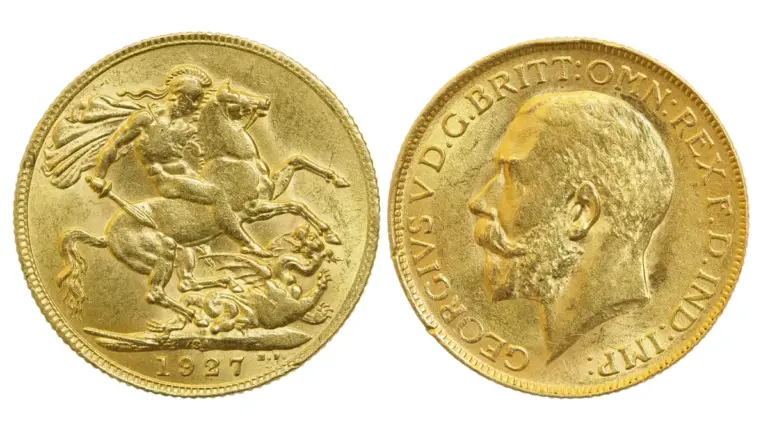
For a private buyer, the result is simple: standard bullion bars and well-known bullion coins are VAT free. That includes the Sovereign, the gold Britannia, the Krugerrand, the Maple Leaf and the Philharmonic.
Which bar weights are accepted?
Section 15 of Notice 701/21 lists the bar weights that HMRC accepts as “weights accepted by the bullion markets”. A bar in one of these sizes, at 995 fineness or higher, is investment gold:
| Unit | Accepted weights |
|---|---|
| London Good Delivery bar | 12.5 kilogram |
| Kilogram | 1 kilogram |
| Gram | 500 g, 250 g, 100 g, 50 g, 20 g, 10 g, 5 g, 2.5 g, 1 g |
| Ounce | 100 oz, 10 oz, 5 oz, 1 oz, ½ oz, ¼ oz |
| Tael | 10 tael, 5 tael, 1 tael |
| Tola | 10 tola |
Source: HMRC, VAT Notice 701/21, section 15 (list of weights accepted by the bullion markets).
What about purity? Check the fineness stamped on the bar: both 999 and 999.9 pass the 995 minimum. Our glossary entry on fineness explains how the numbers work.
The 180% rule for gold coins
Coins have one extra test: the price. A coin type is exempt only if it normally sells for no more than 180% of the value of the gold it contains. HMRC says the test uses the “normal” selling price of the coin type, in the condition in which it is most often traded.
Why does this matter? Bullion coins sell a few per cent above their gold value, so they pass easily. A rare or collector coin that sells far above its gold value may fail the test. In that case, HMRC treats it as a standard-rated supply, with 20% VAT. Our glossary page on numismatic coins covers the difference between bullion and collector pieces.
VAT on Silver in the UK
Silver is a different story. The Royal Mint states that physical silver and platinum bullion, regardless of the country of issue, are subject to VAT at the current rate of 20%. There is no investment silver exemption in UK law.
The rule is the same for every form:
- silver bars of any size, from 1 oz to 1 kg and 100 oz,
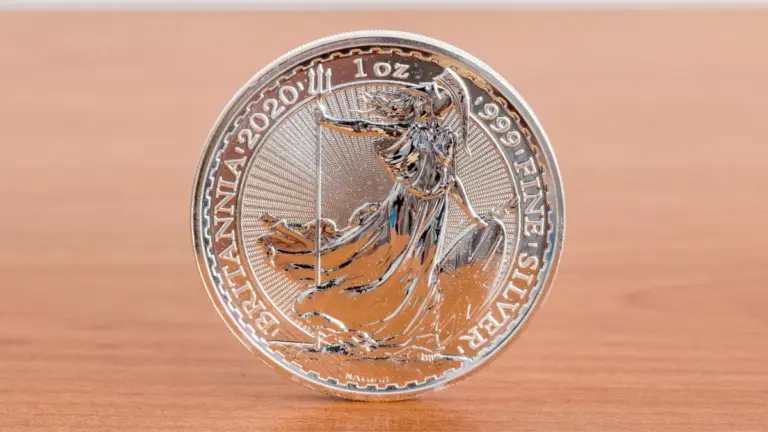
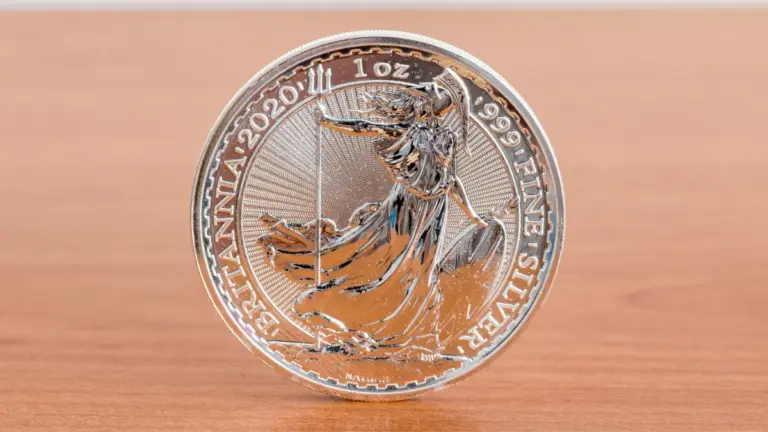
- silver Britannias, even though they are British legal tender,
- foreign silver coins such as the Maple Leaf, the Philharmonic or the Kangaroo.
The UK standard rate of VAT has been 20% since 4 January 2011, according to GOV.UK. More on the choice between formats: Silver Bars or Coins: Which Should UK Investors Buy?
The 20% floor under every silver price
VAT puts a floor under the price of silver. On 27 October 2026, the spot price of silver was £39.99 per troy ounce. Add 20% VAT and one ounce costs £47.99 before the dealer earns a penny.
So when you see a silver coin priced “36% above spot”, more than half of that gap is tax. The rest is the dealer’s premium over spot: minting, shipping, insurance and margin.
Why is there VAT on silver but not gold?
Because the law treats gold as a financial asset and silver as a commodity. The Royal Mint puts it plainly: almost everything we buy in the UK is subject to VAT, and there has to be a good reason for the government not to add it. Gold got that reason in 2000. Silver and platinum did not.
VAT on Platinum and Other Metals
Platinum follows silver. The Royal Mint confirms that physical platinum bullion carries 20% VAT in the UK. With platinum spot at £1,132.44 per ounce on 27 October 2026, VAT alone takes the floor price to £1,358.93 per ounce.
There is one exception worth knowing. The Royal Mint’s DigiSilver and DigiPlatinum products are exempt from VAT, according to the mint. They are digital products, not coins or bars you take home, and they come with their own costs and terms. You can follow the price of the metal itself on our platinum price chart.
How Much VAT Do You Really Pay? Real UK Prices
Rules are one thing. What does VAT do to an actual purchase? We took prices from two UK dealers tracked by our price service on 27 October 2026 and split each one into metal, VAT and dealer premium.
A quick note on the maths. VAT at 20% is added to the net price, so it makes up one sixth of the final price:
VAT in the price = price including VAT ÷ 6
A £57.43 coin therefore holds £9.57 of VAT. Here is the full picture:
| Product (dealer) | Price incl. VAT | Metal at spot | VAT | Dealer premium | Above spot |
|---|---|---|---|---|---|
| Gold Britannia 1 oz (Tavex UK) | £3,116.59 | £3,003.56 | £0 | £113.03 | 3.8% |
| Gold Britannia 1 oz (Hatton Garden Metals) | £3,121.89 | £3,003.56 | £0 | £118.33 | 3.9% |
| Gold bar 100 g (Tavex UK) | £9,971.71 | £9,656.66 | £0 | £315.05 | 3.3% |
| Silver Maple Leaf 1 oz (Hatton Garden Metals) | £54.59 | £39.99 | £9.10 | £5.50 | 36.5% |
| Silver Britannia 1 oz (Hatton Garden Metals) | £57.43 | £39.99 | £9.57 | £7.87 | 43.6% |
| Silver bar 10 oz (Hatton Garden Metals) | £531.28 | £399.90 | £88.55 | £42.83 | 32.9% |
| Silver bar 100 oz (Hatton Garden Metals) | £5,124.50 | £3,999.00 | £854.08 | £271.42 | 28.1% |
Spot on 27 October 2026: gold £3,003.56, silver £39.99 per troy ounce. Prices before delivery (Tavex UK adds £5). Hatton Garden Metals shows silver prices without VAT on its product pages; the figures above include the 20% VAT added at checkout. Source: Metals Radar price service, 27 October 2026.
The chart shows the same split as shares of the price:
What the numbers show
Three things stand out:
- On silver, VAT is often the biggest cost after the metal itself. On a silver Britannia, VAT (£9.57) was larger than the dealer premium (£7.87).
- Large silver bars cut the dealer premium, not the VAT. The 100 oz bar had the lowest premium of all silver products, yet VAT still made up one sixth of the price.
- On gold, the whole gap to spot is dealer premium. At 3.3% to 3.9%, it was smaller than the VAT share on any silver product.
An example with £10,000
Say you have £10,000 to put into bullion. How much of it goes to HMRC?
- in gold bars or gold coins: nothing, because investment gold is exempt,
- in silver bars or coins: £1,666.67, one sixth of the money, whatever the product.
That is the real cost of VAT on silver. It does not depend on the dealer or the size of the bar. Only the dealer premium does.
Does VAT Come Back When You Sell?
No. When you sell bullion back to a dealer as a private person, you do not add VAT to the price. GOV.UK explains that VAT is a tax added to products sold by VAT-registered businesses, so it is something you pay as a buyer, not something you charge as a private seller.
For silver, that matters a lot. Dealers in our data paid between 9.8% below and 4.8% above spot for silver they bought back, while their selling prices included 20% VAT. The bid-ask spread on silver is therefore wide, and VAT is a large part of it.
How far must the price rise before you break even?
We took each dealer’s own selling and buy-back price for the same product and worked out how much the spot price would have to rise before the buy-back price matched what you paid:
Gold needed a rise of 3.1% to 10.3%. Silver needed 23.8% to 60.7%. For context, the silver price in sterling rose 12.3% over the past year, from £35.62 on 27 October 2025 to £39.99 on 27 October 2026, according to our price history.
What does this mean for you? Silver can still suit long-term buyers. But VAT makes it a poor choice for money you might need back within a year or two. Check today’s prices on our silver price chart and gold price chart.
Is Gold Jewellery VAT Free?
No. Gold jewellery is not investment gold. A ring or a chain is not a bar of 995 fineness in a recognised weight, and it is not a coin. HMRC’s Notice 701/21 says that supplies of gold other than investment gold remain taxable at the standard rate, so jewellery from a UK shop carries 20% VAT.
The same applies to gold medals, rounds without legal tender status and most gold items made for wear or display. If you want gold as an investment, a bar or bullion coin is the VAT-free route. To check what a mark on jewellery means, see our guide to gold hallmarks.
Ways UK Buyers Reduce VAT on Silver
You will see many searches and adverts for “VAT free silver”. What is actually possible?
1. Buy gold instead of silver
The simplest way to pay no VAT on precious metals is to buy investment gold. If your aim is to hold metal as a store of value, gold avoids the 20% hurdle completely.
2. Digital or stored silver
The Royal Mint says its DigiSilver is exempt from VAT. Some dealers also advertise “VAT-free storage” for silver held in a vault. Terms differ between providers, so read how VAT applies if you later want the metal delivered to a UK address.
3. Be careful with “margin scheme” claims
A VAT margin scheme taxes only the dealer’s margin, not the full price. It is used for second-hand goods, antiques and collectors’ items. The GOV.UK guide to margin schemes lists precious metals and investment gold among the goods that cannot use it. If a silver price looks far below other UK dealers, ask how VAT has been accounted for before you buy.
4. The Channel Islands
HMRC’s Notice 701/21 notes that there is no VAT in the Channel Islands, which are outside the UK for VAT purposes. The Isle of Man, by contrast, charges VAT under Manx law that generally parallels UK legislation. This is mostly relevant if you live there.
VAT vs Capital Gains Tax: Two Different Taxes
VAT is a tax on buying. Capital Gains Tax (CGT) is a tax on profit when you sell. They follow different rules, and many buyers mix them up.
For CGT, the question is whether the coin is sterling currency. HMRC’s Capital Gains Manual (CG78305) says that Sovereigns minted in 1837 and later and Britannia gold coins are exempt, like all sterling currency. Coins which are currency but not sterling, for example Krugerrands, are chargeable assets.
| Product | VAT when you buy | CGT on gains |
|---|---|---|
| Gold Sovereign, gold Britannia | no | no (sterling currency) |
| Krugerrand, Maple Leaf, other foreign gold coins | no | yes |
| Gold bars (995 fine, accepted weight) | no | yes |
| Silver Britannia | yes, 20% | no (sterling currency) |
| Foreign silver coins, silver bars | yes, 20% | yes |
| Platinum bars and coins | yes, 20% | depends on the product |
| Gold jewellery | yes, 20% | personal possession rules |
Sources: HMRC VAT Notice 701/21; The Royal Mint; HMRC Capital Gains Manual CG76881 and CG78305. General information, not tax advice.
Where CGT applies, you pay it only on gains above your annual tax-free allowance, which is £3,000 according to GOV.UK. From 6 April 2026, the rates are 18% within the basic rate band and 24% above it.
The best tax position for a UK buyer is therefore the gold Britannia and the Sovereign: no VAT and no CGT. Read also: Gold Sovereign: All You Need to Know as a UK Investor.
Summary: VAT on Gold and Silver in the UK
| Question | Answer |
|---|---|
| VAT on investment gold bars and coins | 0%, exempt |
| VAT on silver bullion | 20%, bars and coins alike |
| VAT on platinum bullion | 20% |
| VAT on gold jewellery | 20% |
| VAT share of a silver price | one sixth (16.7%) |
| Gap to spot in our price table, 27 October 2026 | gold 3.3% to 3.9%, silver 28.1% to 43.6% |
| Rise needed to break even | gold 3.1% to 10.3%, silver 23.8% to 60.7% |
Source: Metals Radar price service, 27 October 2026; HMRC; The Royal Mint; GOV.UK.
FAQ: VAT on Gold and Silver
Is there VAT on gold in the UK?
No, there is no VAT on investment gold in the UK. Gold bars of at least 995 fineness in recognised weights and qualifying gold coins are exempt, while gold jewellery carries the standard 20% rate.
Do you pay VAT on gold coins in the UK?
No, bullion gold coins such as the Sovereign, Britannia and Krugerrand are VAT free. A coin qualifies if it is on HMRC’s list or meets the purity, legal tender and 180% price tests in VAT Notice 701/21.
Is there VAT on gold Sovereigns?
No, gold Sovereigns are investment gold coins and are exempt from VAT. As sterling currency, Sovereigns minted in 1837 and later are also free of Capital Gains Tax.
Is there VAT on silver in the UK?
Yes, silver bullion carries 20% VAT in the UK. The Royal Mint states that physical silver bullion is subject to VAT regardless of the country of issue, so bars and coins are treated the same.
Are silver Britannias VAT free?
No, silver Britannias carry 20% VAT like all physical silver bullion. They are, however, free of Capital Gains Tax because they are UK legal tender.
How much VAT is in the price of a silver coin?
VAT makes up one sixth of the price of any silver coin or bar. On 27 October 2026, a £57.43 silver Britannia contained £9.57 of VAT.
Do I pay VAT when I sell my gold or silver?
No, a private individual does not add VAT when selling bullion to a dealer. You also do not get back the VAT you paid on silver, which is why silver needs a larger price rise to break even.
Why is gold VAT free in the UK?
Gold has been VAT free since 1 January 2000, when the UK introduced the investment gold exemption. The Royal Mint explains that the change put gold on the same footing as other investments, such as shares.
Compare Bullion Prices Before You Buy
VAT decides the floor price, but the dealer decides the rest. In our data, the same products cost noticeably different amounts at different UK dealers, before and after VAT. We track UK dealers every day, so you can compare the total cost of a gold bar, a Sovereign or a silver Britannia side by side.
Start with our gold bar price comparison, the gold Britannia and silver Britannia pages, or browse all UK dealers. Read also: What Is the Cheapest Way to Buy Gold in the UK?
This article is for information only and is not financial or tax advice. Tax rules depend on your circumstances; check with HMRC or a qualified adviser.
Was this article helpful?
Thanks for your feedback!