Key Takeaways
- What it is: the gold premium over spot is the extra you pay above the value of the gold in a bar or coin, and on the morning of 24 November 2026 it ranged from 2.9% to 42.2% at the UK dealers we track.
- Size matters most: the cheapest 1 g bar cost 31.1% over spot, while the cheapest 1 oz coin cost 3.6% and a 100 g bar 2.9%.
- The dealer matters too: the same 1 oz Krugerrand cost £2,870.50 at one dealer and £2,919.47 at another, delivery included.
- Silver looks far more expensive because of VAT: a 1 oz Silver Britannia cost 51.9% over spot, but about half of that gap was 20% VAT.
- The premium is only half the cost: dealers also buy back below their selling price, so the round trip on gold ran from about 3.5% to over 10% in our data.
Most people who check the gold price on the news are surprised when they see a dealer’s price list. The number on the shop page is always higher. That gap is the gold premium over spot, and it decides how much of your money ends up as metal.
In this guide, we explain what the premium is made of, why it changes so much from one product to the next and how to keep it low. We use real prices from our gold coin price comparison and gold bar price comparison, checked on 24 November 2026.
What Is the Gold Premium Over Spot?
The gold premium over spot is the difference between the price you pay for a bar or coin and the value of the pure gold it contains at the current spot price. Our glossary entry on the premium over spot gives the short definition, and this article goes into the numbers.
The spot price is the wholesale price for immediate delivery of large amounts of gold between banks and bullion traders. Nobody sells a single coin to the public at spot. Think of it like the wholesale price of flour: the loaf in the shop always costs more than the flour inside it.
How to calculate the premium
The formula is short:
Premium % = (price paid − spot value of the fine gold) / spot value of the fine gold × 100
Here is a worked example with a 1 oz Krugerrand on 24 November 2026:
- spot price of gold at the time of our check: £2,770.15 per troy ounce,
- fine gold in a Krugerrand: one troy ounce, so the spot value is £2,770.15,
- cheapest UK price in our data: £2,870.50 at Hatton Garden Metals, with free delivery,
- premium: (£2,870.50 − £2,770.15) / £2,770.15 × 100 = 3.6%.
In pounds, that is £100.35 above the value of the gold. Easy enough, right? The tricky part is the fine gold weight. A sovereign weighs 7.98 g but holds 7.32 g of pure gold, so you always divide by the gold content, not the gross weight.
Premium in pounds or in per cent?
Always compare in per cent. A £50 premium sounds small on a 1 oz coin and huge on a 1 g bar. Per cent puts every product on the same scale, whatever its size.
What Makes Up the Premium?
The premium is not just dealer profit. It covers a chain of real costs between the mine and your hand. Most of them fall into five groups:
- Refining and minting: turning raw gold into a stamped bar or a struck coin costs money, and this cost is similar for a 1 g bar and a 20 g bar.
- Packaging and certification: small bars usually come sealed in a card with a serial number and an assay certificate.
- Dealer costs and margin: staff, premises, website, card fees and the dealer’s profit.
- Delivery and insurance: some dealers build this into the price, others add a flat fee at checkout.
- Supply and demand: when many buyers want the same coin at once, dealers can raise the premium, and when demand is quiet, premiums usually come down.
There is a sixth item for some products: collector value. A coin with a limited mintage or a yearly design can sell well above a plain bullion coin. That extra is called a numismatic premium, which we explain in our glossary entry on numismatic coins.
Gold Premiums by Size at UK Dealers
Size has the biggest effect on the premium. We took the cheapest offer for each size at the UK dealers in our price service on the morning of 24 November 2026, including delivery where the dealer lists it.
The pattern is steep at the small end and flat at the top. Once you reach around 20 g, the premium drops into single digits and stays there. Above 1 oz, the extra savings are small.
| Product | Fine gold | Lowest price | Premium over spot | Premium in pounds |
|---|---|---|---|---|
| 1 g gold bar (Valcambi) | 1 g | £116.72 | 31.1% | £27.66 |
| 1 g Panda gold coin | 1 g | £99.54 | 11.8% | £10.48 |
| Half sovereign | 3.66 g | £350.74 | 7.6% | £24.67 |
| 5 g gold bar (Heraeus) | 5 g | £506.74 | 13.8% | £61.43 |
| Sovereign | 7.32 g | £675.11 | 3.5% | £22.96 |
| 10 g gold bar (Valcambi) | 10 g | £973.57 | 9.3% | £82.95 |
| 20 g gold bar (Valcambi) | 20 g | £1,897.05 | 6.5% | £115.80 |
| 1 oz Krugerrand | 31.10 g | £2,870.50 | 3.6% | £100.35 |
| 100 g gold bar (Metalor) | 100 g | £9,166.11 | 2.9% | £259.88 |
| 1 kg gold bar (Tavex) | 1,000 g | £91,900.35 | 3.2% | £2,838.05 |
Two results stand out. A 1 g Panda coin carried a much lower premium than any 1 g bar that day, and the sovereign beat every product under 1 oz. You can see how 1 g pricing looks right now on our 1 gram gold bars page.
Why small bars cost so much more
Making, packing and shipping a 1 g bar costs the refiner almost as much as a 10 g bar. Those fixed costs are spread over far less gold. So the premium per gram climbs fast as the bar gets smaller.
Does that make small bars a bad buy? Not always. A 1 g bar is a fine gift or a first step. As a store of value, though, it is the most expensive way to hold gold. We compare budgets in detail in our guide to the minimum amount to invest in gold.
Large bars: the floor of the market
Among the gold we track, 100 g and 1 kg bars came in at about 3%. Our 100 gram gold bars page lists the current offers. For most private buyers, though, a 1 kg bar is a lot of money in one piece, and it is harder to sell part of it later. Our article on large or small denominations covers that trade-off.
Coins vs Bars: Which Carries a Lower Premium?
The usual rule says bars are cheaper than coins of the same weight. In our UK data, the rule did not hold at 1 oz.
- the cheapest 1 oz coin (Krugerrand) cost 3.6% over spot,
- the cheapest 1 oz bar (Valcambi at Hatton Garden Metals) cost 4.7% over spot,
- at 1 g, the Panda coin (11.8%) also beat the cheapest bar (31.1%).
Why? Popular bullion coins sell in huge numbers, so dealers compete hard on them. The sovereign is a good British example: at 3.5%, it was close to 1 oz coin pricing despite holding less than a quarter of an ounce. Read more in our guide to the gold sovereign.
Coins also have a UK tax angle. HMRC’s Capital Gains Manual (CG78305) says sovereigns and Britannia gold coins are sterling currency and exempt from Capital Gains Tax, while coins that are currency but not sterling, such as Krugerrands, are chargeable assets. A slightly higher premium on a Britannia can still pay off if you expect a large gain. Our comparison of gold bars vs gold coins goes further.
When a coin’s premium gets too high
There is an unusual limit in UK VAT rules. Under HMRC VAT Notice 701/21, a gold coin counts as investment gold (and is exempt from VAT) only if, among other tests, it is a type normally sold for no more than 180% of the open market value of its gold. In other words, a coin whose premium is normally above 80% may lose the VAT exemption. No bullion coin in our data came close; the highest 1 oz gold premium was 8.4%, for a 2024 Lunar Dragon.
The Same Coin, Different Prices: Dealer Premiums Compared
The second big driver is the dealer. Prices for identical coins can differ by a noticeable amount on the same morning. Here is what we found for 1 oz coins and the sovereign:
| Product | Hatton Garden Metals | Tavex UK | Difference |
|---|---|---|---|
| 1 oz Krugerrand | £2,870.50 (3.6%) | £2,919.47 (5.4%) | £48.97 |
| 1 oz Maple Leaf | £2,872.36 (3.7%) | £2,905.46 (4.9%) | £33.10 |
| 1 oz Vienna Philharmonic | £2,886.54 (4.2%) | £2,916.67 (5.3%) | £30.13 |
| 1 oz American Eagle | £2,898.61 (4.6%) | £2,961.50 (6.9%) | £62.89 |
| 1 oz Britannia | £2,894.91 (4.5%) | £2,919.47 (5.4%) | £24.56 |
| Sovereign | £675.11 (3.5%) | £684.53 (5.0%) | £9.42 |
On one coin, £25 to £60 may not sound like much. On a stack of ten Krugerrands, the gap reaches almost £490. That is why we always compare the final price, delivery included, rather than the headline price. You can check every current listing for the Krugerrand on our comparison page.
Watch the delivery fee on small orders
A flat delivery fee hits small orders hardest. A £5 charge adds about 0.2% to a 1 oz coin but about 4% to a 1 g bar costing around £117. If a dealer charges for delivery, it is often cheaper to combine purchases into one order.
Why Silver Premiums Look So High in the UK
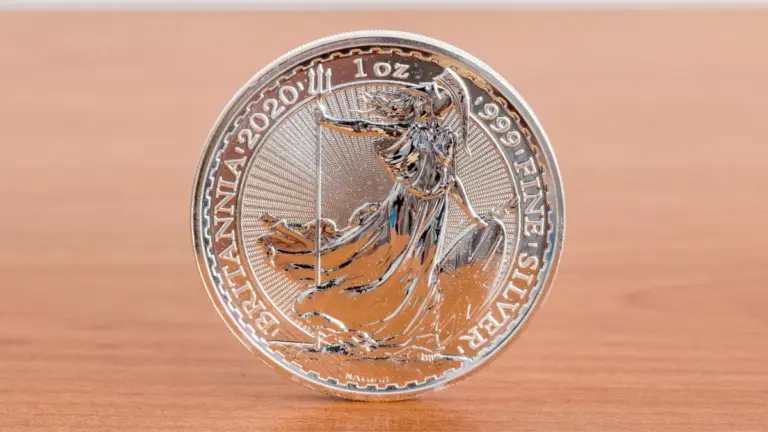
If you think gold premiums are steep, look at silver. On 24 November 2026, a 1 oz Silver Britannia cost £49.00 at Hatton Garden Metals, against a spot value of £32.26. That is 51.9% over spot.
So is silver a rip-off? Not quite. The main reason is VAT. Investment gold is exempt, but silver does not qualify, so it carries VAT at the standard rate of 20% listed on GOV.UK. When we take VAT out of the price, assuming it is included as UK retail prices normally are, the picture changes:
A 100 oz silver bar at £4,123.98 (Baird & Co) looks 27.8% over spot, but only about 6.5% of that is premium before VAT. The rest is tax. Our article on VAT on gold and silver in the UK explains the rules in full.
Even without VAT, small silver coins carry high premiums, because a 1 oz silver coin costs nearly as much to mint as a 1 oz gold coin but holds metal worth about £32. That is why many silver buyers pick bars or larger coins. Our guide on silver bars or coins compares the options, and you can see current offers on our silver bar page.
Do Premiums Change Over Time?
Yes, premiums move, and not always in step with the spot price. Dealers set their own prices, and the premium reflects how much stock they hold and how many people want to buy.
Here are the usual triggers:
- sharp price falls, when many buyers rush in at once and popular coins sell out,
- crises and market panics, when demand for physical gold jumps faster than mints can supply it,
- quiet markets, when dealers compete for fewer buyers and premiums usually ease,
- new releases, when a coin’s first year of issue can sell above older years.
The spot price itself has been anything but calm. In our data, gold fell from £3,390.82 per ounce on 26 August 2026 to £2,769.65 on 24 November 2026. You can follow it on our gold price chart. A premium that looks fair one month can look high the next, so check it again before every purchase.
The Premium You Get Back: Buy-Back and Spread
Paying the premium is only half the story. When you sell, a dealer usually pays you less than its own selling price. The gap between the two is the spread, also called the bid-ask spread.
Our UK buy-back data from the same morning shows how wide it can be:
| Product | Dealer | Dealer pays you | Versus spot | Spread |
|---|---|---|---|---|
| 1 kg gold bar | Tavex UK | £88,730.37 | −0.32% | 3.46% |
| 1 oz Britannia (gold) | Tavex UK | £2,773.76 | +0.19% | 4.84% |
| 1 oz Krugerrand | Tavex UK | £2,731.95 | −1.32% | 6.27% |
| 1 oz Krugerrand | Hatton Garden Metals | £2,674.80 | −3.39% | 6.90% |
| 10 g gold bar | Hatton Garden Metals | £860.62 | −3.32% | 10.35% |
| Sovereign | Hatton Garden Metals | £629.09 | −3.48% | 10.38% |
| 1 kg silver bar | Tavex UK | £1,031.75 | −0.85% | 25.87% |
What does this tell you? A low buying premium only helps if the dealer also pays a fair price when you sell. Large bars and popular coins come out best on both sides. Silver, with VAT paid on the way in and no VAT refund on the way out, has the widest gap. When the time comes, compare offers on our sell gold page.
Your break-even point
Put the two sides together and you get the rise in gold you need before you can sell without a loss. A rough rule: add the premium you paid to the discount the dealer takes when buying back. With a 3.6% premium and a buy-back 3.4% below spot, gold needs to rise by about 7%. With a 31% premium on a 1 g bar, it needs to rise by over a third.
How to Pay a Lower Gold Premium
You cannot avoid the premium, but you can shrink it. These steps made the biggest difference in our data:
- buy the largest size you can comfortably afford and might still want to sell in one piece,
- choose popular bullion coins (Krugerrand, Maple Leaf, sovereign, Britannia) over collector issues,
- compare the final price including delivery at more than one dealer,
- combine small purchases into one order if the dealer charges for delivery,
- check the dealer’s buy-back price before you buy, not after,
- buy from established dealers with LBMA-approved products; our LBMA guide explains which names to look for.
Want a fuller list? Our guide on the cheapest way to buy gold in the UK covers payment methods, timing and storage costs as well.
Summary: Gold Premium Over Spot
| Product group | Typical premium in our data | What drives it |
|---|---|---|
| 1 g to 5 g gold bars | 13.8% to 42.2% | Fixed making and packing costs on tiny weights |
| Sovereigns and 1 oz gold coins | 3.5% to 6.9% (up to 8.4% for a Lunar coin) | Competition between dealers, collector demand |
| 100 g and 1 kg gold bars | 2.9% to 4.4% | Lowest cost per gram |
| Silver coins and bars | 27.8% to 105.7% including VAT (Lunar coins at the top) | 20% VAT, high minting cost per pound of metal |
FAQ: Gold Premium Over Spot
How much over spot should I pay for gold?
For 1 oz bullion coins and sovereigns, a premium of about 3% to 7% was normal at UK dealers on 24 November 2026. Small bars of 1 g to 5 g cost 13% to over 40% more than their gold value.
Why is gold more expensive than the spot price?
Gold is more expensive than spot because the spot price is a wholesale price for large amounts. A bar or coin adds refining, minting, packaging, delivery and the dealer’s costs and margin on top.
Can you buy gold at spot price?
No, private buyers in the UK cannot normally buy physical gold at spot. The lowest premium in our data on 24 November 2026 was 2.9%, for a 100 g bar.
Do gold coins have a higher premium than bars?
Not always. On 24 November 2026, the cheapest 1 oz coin in our UK data cost 3.6% over spot, while the cheapest 1 oz bar cost 4.7%.
Why is the premium on silver so much higher than on gold?
The silver premium is higher mainly because UK buyers pay 20% VAT on silver, while investment gold is exempt. Silver coins also cost a similar amount to mint as gold coins but contain metal worth far less.
Do you get the premium back when you sell gold?
Usually not in full. In our data, UK dealers bought back gold at between 4.3% below and 0.2% above spot, so the premium you paid is mostly a cost, and gold needs to rise before you break even.
How do I calculate the premium over spot?
Subtract the spot value of the fine gold from the price you pay, divide the result by that spot value and multiply by 100. For a 1 oz coin at £2,870.50 with spot at £2,770.15, the premium is 3.6%.
Compare Premiums Before You Buy
The gold premium over spot is the one cost you control. The spot price is the same for everyone, but the premium on top changes with the product, the size and the dealer.
Before you buy, compare live prices for 1 oz gold bars and coins, and check the UK dealers we track. A few minutes of comparison can save you more than a year of price moves.
This article is for information only and is not investment or tax advice.
Was this article helpful?
Thanks for your feedback!