Key Takeaways
- People buy gold mainly for safety and diversification: physical gold has no counterparty, and over the long run it has held its value, rising 9% a year in US dollars since 1971 according to the World Gold Council.
- The UK tax rules favour gold: investment gold is VAT-free, and Sovereigns and gold Britannias are exempt from Capital Gains Tax.
- Gold is not a one-way bet: in pounds it fell 25.9% between 2 March and 16 July 2026, even after a strong 2025.
- Costs are low if you choose well: on 3 October 2026 the cheapest 1 oz Krugerrand cost 1.2% over spot at a UK dealer, while a 1 g bar cost 23.7% over spot.
- Gold pays no income: it suits a part of your savings you can hold for years, not money you need next month.
Why buy gold when you could keep your money in a savings account, a pension fund or shares? It is a fair question. Gold pays no interest, it has to be stored, and its price can fall. Yet central banks bought 863 tonnes of it in 2025, and private investors around the world bought 1,374 tonnes of bars and coins in the same year, according to the World Gold Council.
In this guide we go through the main reasons to buy physical gold, the downsides most sellers skip, and what gold really costs at UK dealers tracked by metalsradar. You will find charts, tables with real GBP prices, UK tax rules and an FAQ at the end.
Why Buy Gold? The Short Answer
Most people buy gold for one or more of these reasons:
- to hold something that does not depend on a bank, a company or a government,
- to protect part of their savings over the long term,
- to balance shares and bonds with an asset that often moves differently,
- to benefit from UK tax rules on investment gold.
Should gold be your only investment? No, it works best as one part of a wider plan.
1. Physical Gold Has No Counterparty Risk
Counterparty risk is the chance that the other side of a deal fails to pay. A bank deposit depends on the bank. A bond depends on the issuer. A share depends on the company.
A gold coin in your hand depends on nobody. It does not need a company to stay in business or a government to keep a promise. This is the reason many people prefer physical gold to paper products that track the price.
There is one caveat. If you store gold with a dealer or a vault, you rely on that provider’s systems and insurance. Buying physical bullion is also not regulated by the Financial Conduct Authority, as The Royal Mint points out in its guidance, so the Financial Services Compensation Scheme does not cover a dealer failure. Choose established dealers and check how your metal is held.
2. Gold Has Held Its Value Over the Long Run
Gold has been valued for thousands of years. Modern data also back up its long-term record. According to the World Gold Council (Gold as a Strategic Asset, 2026 edition), the price of gold in US dollars has risen by 9% a year on average since 1971, when the US gold standard ended.
That long-run average hides big swings. Here is the gold price in pounds over the last 12 months:
Gold rose from £2,876 to a peak of £4,005 on 2 March 2026, then fell 25.9% to £2,968 by 16 July 2026. On 3 October 2026 it was £3,136, still 9.0% higher than a year earlier. Follow the latest moves on our gold price chart.
3. Gold Can Help Against Inflation
Inflation reduces what your pounds can buy. Gold cannot be printed, and its supply grows slowly. Over long periods it has tended to keep up with rising prices.
The World Gold Council reports that in years when inflation was between 2% and 5%, the gold price rose by 10% a year on average, measured in US dollars. That is an average across many years, not a promise for any one year. In the short term, interest rates, the dollar and investor mood can push gold down even while inflation is high.
So is gold a perfect inflation hedge? No, it is a long-term one that can disappoint over a single year.
4. Gold Diversifies a Portfolio
Diversification means holding assets that do not all fall at the same time. Gold is driven by different forces from shares: interest rates, the US dollar, central bank buying and fear in the markets.
When the US Congress asked about gold in 2011, Ben Bernanke, then chairman of the Federal Reserve, put it this way:
“I think the reason people hold gold is as a protection against what we call tail risk, really, really bad outcomes.”
Ben Bernanke, Chairman of the Federal Reserve, testimony to the US House Financial Services Committee, July 2011
That is why many investors hold a slice of gold next to shares and bonds. It will not rise every time shares fall, and it can fall on its own, as the chart above shows. But its different drivers can make the whole portfolio less bumpy.
Read also: Gold Bars vs Gold Coins: Pros and Cons for UK Investors
5. Central Banks Keep Buying Gold
Central banks are among the largest gold buyers in the world. According to the World Gold Council, they added 863 tonnes to their reserves in 2025. Total gold demand reached a record 5,002 tonnes that year.
The World Gold Council linked that record to the wider mood among buyers:
“Consumers and investors alike bought and held gold in an environment where economic and geopolitical risks have become the new normal.”
Louise Street, Senior Markets Analyst, World Gold Council, Gold Demand Trends full year 2025 press release, January 2026
Who holds all the gold that exists? The WGC estimates there were about 222,600 tonnes above ground at the end of Q2 2026:
When the institutions that manage national reserves keep adding gold, it signals long-term trust in the metal. It also creates steady demand that private buyers do not have to provide alone.
6. Gold Supply Grows Slowly
The world mined about 3,300 tonnes of gold in 2025, according to the US Geological Survey. Compared with roughly 222,600 tonnes already above ground, that adds only about 1.5% a year to the total stock.
Almost all of that stock still exists, because gold does not rust or tarnish and is rarely thrown away. A slow, steady supply is one reason gold has kept its value over long periods.

7. UK Tax Rules Favour Investment Gold
This is where buying gold in the UK stands out. Two taxes matter:
- VAT: investment gold is exempt under HMRC VAT Notice 701/21. That covers bars of at least 995 fineness in weights accepted by the bullion markets, and coins minted after 1800 of at least 900 fineness that are or were legal tender and normally sell for no more than 180% of their gold value. Silver, by contrast, carries 20% VAT.
- Capital Gains Tax: HMRC’s Capital Gains Manual states that Sovereigns minted from 1837 and gold Britannias are sterling currency and therefore exempt. Bars and foreign coins such as Krugerrands are chargeable assets.
| Product | VAT | Capital Gains Tax | In a SIPP? |
|---|---|---|---|
| Gold Sovereign (1837 onwards) | Exempt | Exempt | No (coins are outside HMRC’s bullion exception) |
| Gold Britannia | Exempt | Exempt | No |
| Krugerrand, Maple Leaf, other foreign coins | Exempt | Chargeable | No |
| Gold bars (995 fine or better) | Exempt | Chargeable | Yes, through a provider that offers it |
For chargeable gold, the annual CGT allowance is £3,000 per person. Gains above that are taxed at 18% or 24%, depending on your income, according to GOV.UK. Note that CGT-free coins still count towards your estate for Inheritance Tax.
8. Gold Is Easy to Sell
Gold is traded around the world, and well-known coins and bars can be sold back to most bullion dealers. The real question is how much you lose between buying and selling. Here is what two UK dealers charged and paid on the same day:
| Product | Dealer | Dealer sells at | Dealer buys back at | Spread |
|---|---|---|---|---|
| Gold bar 1 kg | Tavex UK | £102,628.15 | £99,570.99 | 3.0% |
| Krugerrand 1 oz | Hatton Garden Metals | £3,173.61 | £3,072.25 | 3.2% |
| Canadian Maple Leaf 1 oz | Hatton Garden Metals | £3,175.67 | £3,074.23 | 3.2% |
| Britannia 1 oz | Tavex UK | £3,232.78 | £3,103.26 | 4.0% |
| Gold Sovereign | Hatton Garden Metals | £786.85 | £722.56 | 8.2% |
| Gold bar 10 g | Hatton Garden Metals | £1,076.45 | £988.50 | 8.2% |
Larger and more popular products have the narrowest spreads. Small items like Sovereigns and 10 g bars cost more to buy and sell, in exchange for flexibility. If you might need part of your money back, compare both sides of the price before you buy. You can also check what dealers pay on our sell gold page.
9. Gold Is Easy to Divide and Pass On
Gold comes in many sizes, from a 1 g bar to a 1 kg bar and beyond. A Sovereign contains 0.2354 troy ounces of gold and is easy to give or split among family members. Many families give coins at births, weddings and other milestones.
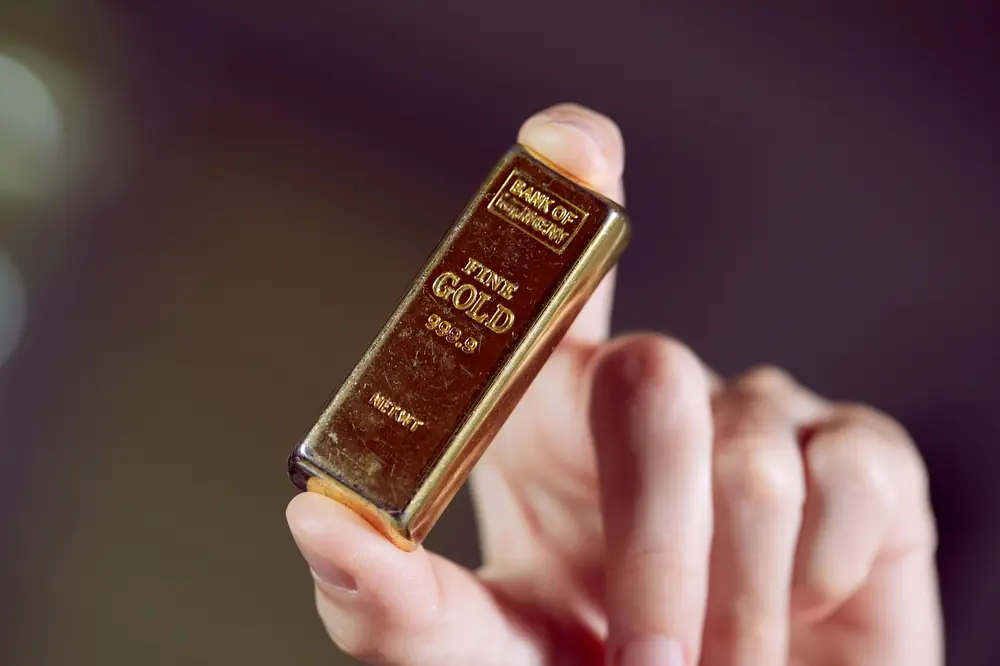
Two practical tips help here. Keep your purchase invoices, because they prove what you paid and help with any tax calculation. And keep coins in their original capsules or packaging, because damaged items can sell for less.
Read also: Large or Small Denominations: What’s Better When Buying Gold?
The Downsides of Buying Gold
An honest answer to “why buy gold” includes the reasons not to. Before you buy, weigh these:
- No income: gold pays no interest or dividends, so you give up the return cash or shares could earn.
- Price falls: gold dropped 25.9% in pounds between March and July 2026.
- Premiums and spreads: you pay above spot to buy and receive below spot to sell.
- Storage and insurance: a home safe or a vault costs money, and many home insurance policies limit cover for bullion.
- Fakes: counterfeit coins and bars exist. Learn the checks in our guide to spotting fake gold and silver coins.
- Tax on some products: bars and foreign coins are subject to CGT above the annual allowance.
What Does Gold Cost in the UK Today?
The premium is what you pay above the value of the gold itself. It is calculated as (price − spot value) / spot value × 100. On 3 October 2026, the spot price was £3,135.89 per troy ounce. Here are the lowest listed prices for popular products at UK dealers in our data:
| Product | Lowest price | Dealer | Premium over spot |
|---|---|---|---|
| Krugerrand 1 oz | £3,173.61 | Hatton Garden Metals | 1.2% |
| Canadian Maple Leaf 1 oz | £3,175.67 | Hatton Garden Metals | 1.3% |
| Gold bar 1 kg | £102,628.15 | Tavex UK | 1.8% |
| Gold bar 100 g | £10,373.48 (+£10 delivery) | Tavex UK | 2.9% |
| Britannia 1 oz | £3,232.78 (+£5 delivery) | Tavex UK | 3.1% |
| Gold bar 1 oz | £3,248.42 (+£5 delivery) | Tavex UK | 3.6% |
| Gold Sovereign | £786.85 | Hatton Garden Metals | 6.6% |
| Gold bar 1 g | £124.76 (+£5 delivery) | Tavex UK | 23.7% |
Two patterns stand out. Popular 1 oz coins can cost less over spot than 1 oz bars. And very small bars are an expensive way to own gold: a 1 g bar cost almost 24% more than its gold value. Compare live prices for Krugerrands, gold Britannias and 100 g gold bars before you choose.
How to Buy Gold in the UK
Buying physical gold is simple if you follow a few steps:
- Set your budget and goal: decide how much of your savings you want in gold and for how long.
- Choose the product: coins for flexibility and UK tax benefits, larger bars for the lowest premium.
- Compare dealers: check the premium over spot, delivery cost and buy-back price.
- Check the dealer: look for an established business with clear terms. Our dealer directory lists UK bullion dealers.
- Plan storage: a home safe, a bank box or a professional vault, with insurance.
- Keep records: invoices and certificates make selling and tax easier.
Read also: What is the Proper Way to Store Gold: Best Practices Explained
Summary: Why Buy Gold?
| Reason | What the data show |
|---|---|
| No counterparty risk | Physical gold does not rely on a bank or company |
| Long-term value | 9% a year in USD since 1971 (World Gold Council) |
| Central bank demand | 863 tonnes bought in 2025 |
| UK tax | No VAT; Sovereigns and Britannias free of CGT |
| Low costs on popular coins | Krugerrand from 1.2% over spot; spreads from 3% |
| Main risk | Price falls, such as 25.9% between March and July 2026 |
FAQ: Why Buy Gold?
Is gold a good investment?
Gold can be a good long-term investment as part of a mix of assets. It has risen 9% a year in US dollars since 1971, but it pays no income and can fall sharply, as it did by 25.9% in pounds in 2026.
What is the downside of buying gold?
The main downsides are no income, price falls, storage costs and the gap between buying and selling prices. Bars and foreign coins can also be subject to Capital Gains Tax in the UK.
Do you pay VAT on gold in the UK?
No, investment gold is exempt from VAT under HMRC VAT Notice 701/21. This covers qualifying bars of at least 995 fineness and qualifying gold coins.
Is it better to buy gold coins or gold bars?
It depends on your goal. Sovereigns and Britannias are free of CGT and easy to sell one by one, while larger bars usually have the lowest premium per ounce.
Is it a good idea to buy gold right now?
Nobody can time the gold price reliably. Many investors buy in stages over months, which avoids putting all their money in at a short-term peak like the one on 2 March 2026.
How much of my savings should be in gold?
There is no rule that fits everyone. Many investors keep gold as a smaller part of a diversified portfolio, sized so that a 25% fall would not change their plans.
Is gold safer than cash in the bank?
Not in every sense. Bank deposits are protected by the FSCS up to its limit and pay interest, while gold has no counterparty but its price can fall, so the two do different jobs.
Compare Gold Prices Before You Buy
Once you know why you want to buy gold, the next step is paying a fair price. The same coin can cost several per cent more at one dealer than another on the same day. metalsradar compares UK dealers and shows the premium over spot for every offer, so you can see the difference at a glance.
Check today’s prices for investment gold, compare gold coins and gold bars, or follow the gold price per gram.
This article is for informational purposes only and is not investment or tax advice.
Was this article helpful?
Thanks for your feedback!