Key Takeaways
- A UK gold hallmark has three compulsory marks: the sponsor’s mark, the fineness mark (for example 375 or 750) and the assay office mark.
- The fineness number shows gold content in parts per thousand: 375 is 9 carat, 585 is 14 carat, 750 is 18 carat and 916 is 22 carat.
- Gold items of 1 gram or more must be hallmarked before a UK business can describe or sell them as gold, under the Hallmarking Act 1973.
- Only four UK assay offices can hallmark: London (leopard’s head), Birmingham (anchor), Sheffield (rose) and Edinburgh (castle).
- Gold coins and bullion bars are exempt from hallmarking, so investment gold carries the mint’s or refiner’s stamp instead.
- Fineness drives metal value: on 3 October 2026, a gram of 9 carat gold contained about £37.81 of gold, a gram of 22 carat about £92.41.
You turn over a ring or a chain and find a row of tiny marks: a number, a symbol, a few letters. What do these gold hallmarks tell you? In the UK, quite a lot. A full hallmark tells you how pure the gold is, who sent it for testing, where it was tested and, often, in which year.
In this guide, we explain how to read a UK gold hallmark mark by mark, what 375, 585, 750 and 916 mean in carats, which items must be hallmarked, how to spot a doubtful mark and what each gold standard was worth on 3 October 2026. You will find a summary table and an FAQ at the end.
What Is a Gold Hallmark?
A gold hallmark is a set of marks struck on an item by an independent assay office after the metal has been tested. It is a legal guarantee that the gold is at least as pure as the number says. A stamp applied by a manufacturer, such as “18K” or “750” on its own, is only a claim. A hallmark is proof from a third party.
Why does it matter? You cannot see or feel how much gold an alloy contains. Gold is almost always mixed with other metals, such as silver, copper or zinc, to make it harder or to change its colour. As the UK hallmarking guidance notes put it, it is not possible to detect the gold content of an item by sight or by touch. The hallmark does that job for you.
The law behind it is the Hallmarking Act 1973. Its main offence is about description: a business may not describe an unhallmarked article as gold (unless it is exempt), or supply one described that way. The rule covers shops, market stalls and online sellers dealing with UK consumers, and it applies to new and pre-owned items alike.
How to Read a UK Gold Hallmark
A modern UK hallmark is made of three compulsory marks, and up to three optional ones. Here is how a typical 18 carat mark is laid out:
1. The sponsor’s mark
The sponsor’s mark identifies the company or person who sent the item for hallmarking. In the UK, it consists of at least two letters inside a surround, and no two sponsor’s marks are the same at any one assay office. The sponsor may be the maker, an importer or a retailer.
2. The fineness mark
This is the number you will look at first. It shows the minimum gold content in parts per thousand, so 750 means at least 750 parts of pure gold in every 1,000 parts of metal. The shape of the surround around the number tells you the metal: gold, silver, platinum and palladium each have their own outline.
3. The assay office mark
The town mark shows which office tested and marked the item. There are four UK assay offices today, and each has its own symbol (see the table further down).
Optional marks
Next to the compulsory marks, you may find:
- a crown, the traditional fineness symbol for gold, which the Act allows for all gold standards,
- a date letter, which was compulsory until 1999 and is now voluntary,
- a Common Control Mark (CCM), a pair of scales used under the International Convention on Hallmarks, which the UK signed in 1972,
- occasionally, a commemorative mark struck to celebrate a national event.

Gold Fineness Marks and Carats
What does 375 mean on gold? It means the item is 37.5% pure gold, which is 9 carat. Carats divide gold into 24 parts, so 24 carat is pure gold and 9 carat is 9 parts gold out of 24. The fineness number says the same thing in thousandths.
The UK recognises six gold standards. Here is how they convert, and what the gold in each was worth on 3 October 2026:
| Fineness mark | Carat | Gold content | Gold value per gram, 3 Oct 2026 |
|---|---|---|---|
| 375 | 9 carat | 37.5% | £37.81 |
| 585 | 14 carat | 58.5% | £58.98 |
| 750 | 18 carat | 75.0% | £75.62 |
| 916 | 22 carat | 91.66% | £92.41 |
| 990 | near 24 carat | 99.0% | £99.81 |
| 999 | 24 carat | 99.9% | £100.72 |
9 carat gold hallmarks (375)
9 carat is the lowest legal gold standard in the UK and the most common in British jewellery. It is hard-wearing and cheaper than higher carats. Before 1975, 9 carat gold was marked with “9” and “.375”. Today, you will see 375 in the gold surround.
14 carat (585)
14 carat replaced the old 15 and 12 carat standards in 1932, according to the Goldsmiths’ Company Assay Office. It is more common in continental European and American jewellery than in British pieces.
18 carat (750)
18 carat is three quarters pure gold. It is the classic choice for fine jewellery and wedding rings, and it is made in yellow, white and red versions depending on the alloy. Before 1975, 18 carat items carried a crown and the number 18.
22 carat (916)
22 carat gold has a deep yellow colour and is softer than 18 carat. It is the alloy of the gold sovereign, although coins carry no hallmark (see below). Older pieces show a crown and the number 22.
990 and 999 gold
990 and 999 are near-pure gold. They are rare in jewellery because the metal scratches and bends easily. Most gold of this purity is sold as bullion bars and coins.
What about 10 carat or “18K” stamps?
10 carat (417) is not a UK standard, so it cannot be hallmarked as 10 carat here. A foreign stamp such as “14K” or “18K” without a UK or Convention hallmark is only the maker’s claim. Over the exemption weight, a UK business cannot sell that item as gold until it has been hallmarked.
UK Assay Offices and Their Town Marks
Which town marks will you find on British gold? The four current offices, and their symbols, are set out in Schedule 2 of the Act:
| Assay office | Town mark | Notes |
|---|---|---|
| London (Goldsmiths’ Company) | Leopard’s head | The leopard’s head was required on gold and silver by a statute of Edward I in 1300. It lost its crown in 1822. |
| Birmingham | Anchor | Office set up by Parliament in 1773. |
| Sheffield | Rose | Set up in 1773. The rose was used for gold after Sheffield was allowed to assay gold in 1904, and for all metals after the 1973 Act. |
| Edinburgh | Castle | On Scottish silver, the traditional sterling symbol is a lion rampant instead of a lion passant. |
You may also see town marks from offices that have since closed, such as Chester, Glasgow, Exeter, Newcastle and York. They are common on antique pieces and can be traced in specialist hallmark directories.
Date Letters: When Was Your Gold Hallmarked?
A date letter is a single letter whose typeface, case and shield shape change with each cycle, so that each letter points to one year only. London introduced date letters in 1478. Since 1975, all four UK assay offices have used the same letter, changing on 1 January each year, according to the Sheffield Assay Office. The letter for 2025 is “A”, the start of a new cycle.
Is a missing date letter a bad sign? No, it is not. The date letter has been optional since 1999, so many modern pieces do not have one. For older items, you need both the town mark and the date letter, because each office used its own date letter tables before 1975.
A Short History of Gold Hallmarking
Hallmarking is one of the oldest forms of consumer protection in Britain. The main milestones for gold, according to the Goldsmiths’ Company Assay Office, are:
- 1238: Henry III orders the Mayor and aldermen of London to choose six goldsmiths to supervise the craft,
- 1300: Edward I requires the leopard’s head on gold and silver wares,
- 1363: the maker’s mark becomes compulsory,
- 1478: the gold standard is lowered to 18 carat and the date letter is introduced,
- 1576: the gold standard is raised to 22 carat,
- 1798: 18 carat gold is reintroduced as a standard, marked with a crown and “18”,
- 1854: 9, 12 and 15 carat standards are introduced,
- 1932: 12 and 15 carat are replaced by 14 carat,
- 1973: the Hallmarking Act consolidates the law, coming into force in 1975.
One correction to a common claim: the current law is the Hallmarking Act 1973, not an act of 1975. It took effect on 2 January 1975, which is why 1975 appears in many sources.
Seven centuries on, the assay offices see their job in the same way. When London Trading Standards won the 2025 Touchstone Award for Operation Stamping It Out, which seized more than £250,000 worth of silver and gold jewellery without hallmarks, the head of the London Assay Office said:
“For more than 700 years, the London Assay Office has protected consumers and the trade by ensuring the quality of precious metals.”
Will Evans, Director of the London Assay Office, GOV.UK announcement of the Touchstone Award 2025, July 2025
Which Gold Items Must Be Hallmarked?
In the UK, any article described as wholly or partly gold must be hallmarked, unless it is exempt. The main exemption is weight. Gold items under 1 gram do not need a hallmark. Here are the thresholds for all four precious metals:
| Metal | Exempt below | Minimum fineness |
|---|---|---|
| Gold | 1 gram | 375 |
| Silver | 7.78 grams | 800 |
| Platinum | 0.5 grams | 850 |
| Palladium | 1 gram | 500 |
Other exemptions that matter to buyers
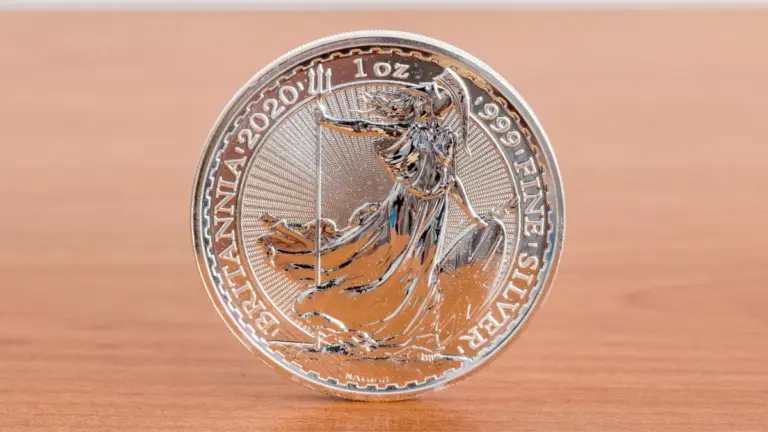
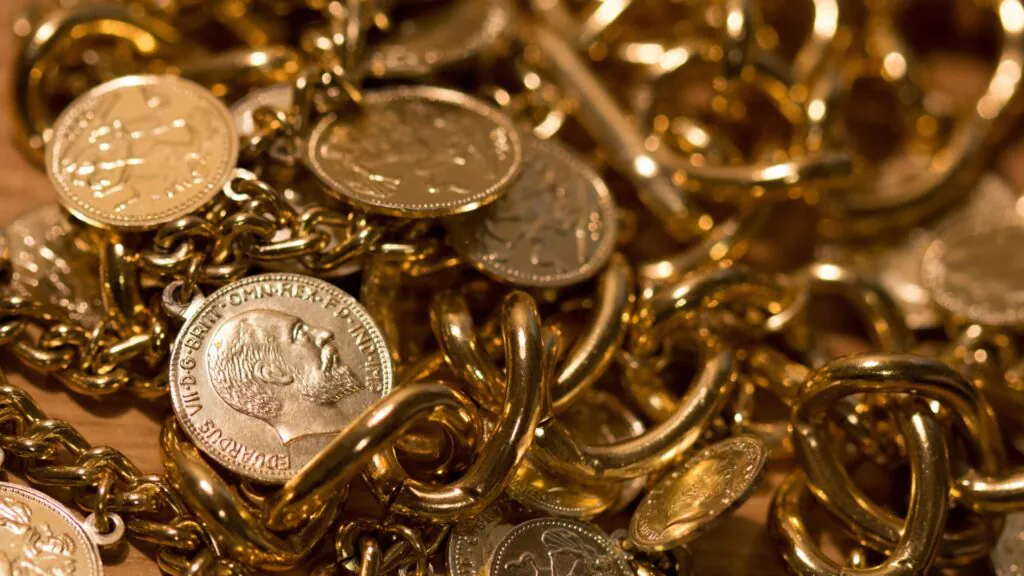
- Coins: any coin that is, or was at any time, current coin of the UK or any other territory is exempt. That covers sovereigns, Britannias and Krugerrands.
- Bullion and raw material: bars, plate, sheet, wire and bullion are exempt.
- Pre-1950 items: an item made before 1950 can be sold as gold without a hallmark if the seller can prove it is at least 375 fine and was made before 1950.
- Older exemptions: before 1975, many gold rings (other than wedding rings) were exempt whatever their weight, so an unmarked old ring is not automatically a fake.
Gold coins and bars: no hallmark, different checks
So how do you check investment gold? Not by hallmark. A bullion bar from a large refiner carries the refiner’s stamp, its weight, fineness and usually a serial number. Coins carry the mint’s design and specifications. Bars that meet the London Bullion Market Association standards come from accredited refiners; read our guide to the LBMA to see what that means.
Tax works differently too. Under HMRC VAT Notice 701/21, investment gold is exempt from VAT. That covers bars and wafers of at least 995 fineness, and coins minted after 1800 that are at least 900 fine, legal tender in their country of origin and normally sold for no more than 180% of the value of their gold. Gold jewellery is not investment gold, so it carries VAT at the standard rate.
For fakes in coin form, see our guide on how to spot fake gold and silver coins, for example the fake gold Britannia checklist.
Dealer’s Notice: What Shops Must Show You
Have you noticed a poster of hallmarks in a jeweller’s window? It is not decoration. Every dealer selling precious metal articles must display the Dealer’s Notice produced by the British Hallmarking Council, which explains the approved hallmarks. In a shop, Notice A must be on show in a conspicuous position where customers are admitted. Online sellers must also prominently display explanatory information about hallmarks, according to GOV.UK guidance on hallmarking.
How to Spot a Fake or Doubtful Gold Hallmark
Forged hallmarks exist, and so do honest foreign stamps that are not UK hallmarks. Watch for these warning signs:
- A number without the other marks: “375” or “750” alone, with no sponsor’s mark and no town mark, is not a UK hallmark.
- Odd numbers: UK gold standards are 375, 585, 750, 916, 990 and 999. A mark such as “416” or “10K” is not a UK standard.
- Blurred or shallow marks: genuine marks are crisp, struck with a punch or applied by laser. Soft, rounded edges may point to a cast copy.
- Wrong combinations: a lion passant (a silver symbol) on an item sold as gold, or a date letter that does not fit the town mark, needs a closer look.
- “Gold plated”, “rolled gold” or “gold filled”: these describe a gold layer on another metal. Gold-plated base metal cannot be hallmarked at all.
- Price too good to be true: compare the asking price with the gold value per gram in the table above.
If in doubt, ask a UK assay office. They can test an item and confirm whether a mark is genuine. Selling an item with a counterfeit hallmark is a criminal offence under the Act.
White gold, rose gold and gold plated silver
White and rose gold carry the same fineness marks as yellow gold: an 18 carat white gold ring is still 750. Gold plated silver, often sold as “vermeil”, is hallmarked as silver. The guidance notes say it must be described as silver, with the word “gold” directly followed by “plated”, for example “18ct gold plated silver ring”.
Selling Hallmarked Gold
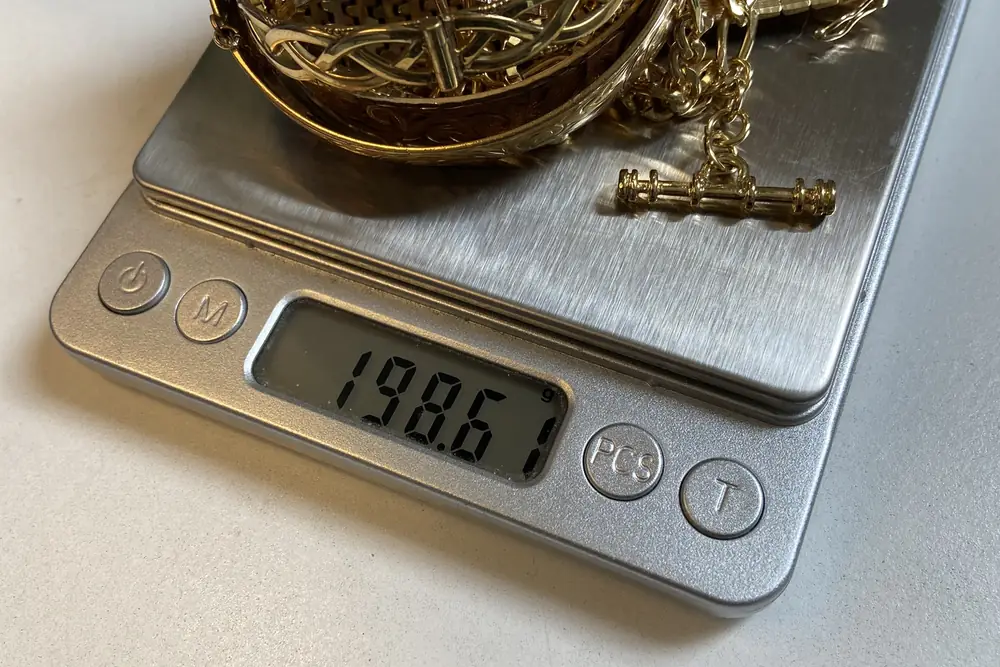
Does a hallmark raise the price a buyer will pay? A hallmark does not add metal, but it makes the gold content clear before testing, which helps you compare offers. For scrap jewellery, buyers pay according to weight and fineness. Here is a simple formula:
Gold value = weight in grams × (fineness ÷ 1,000) × gold price per gram
A 10 gram 9 carat chain contained about £378 of gold on 3 October 2026 (10 × 0.375 × £100.82). Expect a scrap offer below that, because buyers deduct refining costs and their margin. Antique and designer pieces can be worth more than their metal.
Check the gold price per gram before you visit a buyer, and read our page on how to sell gold for tips on comparing offers.
Summary: Gold Hallmarks
| Question | Short answer |
|---|---|
| What are the compulsory marks? | Sponsor’s mark, fineness mark, assay office mark |
| What do the numbers mean? | 375 = 9ct, 585 = 14ct, 750 = 18ct, 916 = 22ct, 990, 999 = 24ct |
| When is a hallmark required? | Gold items of 1 g or more described as gold |
| Who can hallmark? | London, Birmingham, Sheffield and Edinburgh assay offices |
| Are coins and bars hallmarked? | No, they are exempt |
| Is the date letter compulsory? | No, optional since 1999 |
FAQ: Gold Hallmarks
What does 375 mean on gold?
375 means the item is 37.5% pure gold, which is 9 carat. It is the lowest legal gold standard in the UK and the most common in British jewellery.
Is 750 gold real gold?
Yes, 750 gold is real gold: 75% of its weight is pure gold, which makes it 18 carat. The rest is other metals that set its colour and hardness.
How do I identify a UK gold hallmark?
Look for three compulsory marks together: a sponsor’s mark with at least two letters, a fineness number in the surround used for gold, and a town mark such as an anchor or a leopard’s head.
Does all gold jewellery have to be hallmarked in the UK?
No, gold items under 1 gram are exempt, and so are some pre-1950 items. Above 1 gram, a business must have the item hallmarked before describing or selling it as gold.
Are gold coins hallmarked?
No, coins that are or were current coin of any country are exempt from hallmarking. Their purity is set by the issuing mint and shown in the coin’s specification.
What is the crown on a gold hallmark?
The crown is the traditional fineness symbol for gold. Today it is optional and can appear next to any gold fineness number. Before 1975, it was part of the 22 and 18 carat marks.
Can a hallmark be faked?
Yes, hallmarks can be forged, and counterfeiting one is an offence. If a mark looks blurred, incomplete or out of place, ask a UK assay office to test the item.
Compare Gold Prices Before You Buy or Sell
A hallmark tells you how much gold an item contains. It does not tell you whether the price is fair. For investment gold, the difference between dealers often matters more than the difference between two coins of the same weight.
Compare live dealer prices for gold coins and gold bars, follow the gold price in GBP, or browse UK bullion dealers. Read also: Gold Bars vs Gold Coins: Pros and Cons, and for silver marks, our guide to silver hallmarks.
This article is for information only and is not investment or tax advice.
Was this article helpful?
Thanks for your feedback!