Key Takeaways
- The short answer: the American Eagle coin is the official bullion coin of the United States, struck by the US Mint since 1986 in gold and silver, since 1997 in platinum and since 2017 in palladium.
- The Gold Eagle is 22 karat: each coin holds its full stated weight of fine gold, but the metal is 91.67% gold mixed with silver and copper, so a 1 oz coin weighs 33.931 grams.
- The 1 oz size costs least per ounce: on November 2, 2026, the lowest price for a 1 oz Gold Eagle was 1.98% over spot, while the cheapest 1/10 oz coin cost 11.25% over spot.
- You pay a small extra for the brand: the cheapest 1 oz Gold Eagle cost $49.68 more than the cheapest 1 oz Krugerrand at US dealers on the same morning.
- Dealers differ a lot: the same 1 oz Gold Eagle ranged from $3,993.15 to $4,100.45, a gap of $107.30.
Ask an American bullion dealer which coin sells best, and the answer is often the same: the Eagle. It is the coin many US buyers start with, and the one they recognize at a glance.
In this guide to the American Eagle coin, we explain what each Eagle contains, how the gold, silver and platinum versions differ, and what the coins really cost at US dealers on November 2, 2026. The prices come from our American Gold Eagle price comparison and our American Silver Eagle prices, so you can see where the premium is fair and where it is not.
What Is an American Eagle Coin?
An American Eagle coin is a bullion coin made by the United States Mint and backed by the US government for its weight and purity. Bullion means the coin is bought mainly for its metal, not for rarity.
The program started in 1986 with gold and silver coins. Platinum followed in 1997 and palladium in 2017. All four are legal tender with a face value, but nobody spends them at face value. A 1 oz Gold Eagle says $50 on the reverse, yet the gold inside was worth $3,915.70 on November 2, 2026.
So why does a government coin matter to a private buyer? Because the guarantee comes from the issuer, not from a private refiner. Dealers across the country know the coin, which makes it easy to buy and easy to sell.
Who makes American Eagle coins?
The US Mint strikes the coins, but it does not sell bullion Eagles to the public. It sells them only to a network of large wholesale buyers called authorized purchasers. They resell the coins to dealers, and dealers sell them to you. That is why you will not find bullion Eagles in the US Mint online shop, only the proof and uncirculated collector versions.
American Eagle coins at a glance
Here is the whole family in one table:
| Coin | First issued | Metal | Purity | Face value (1 oz) |
|---|---|---|---|---|
| American Gold Eagle | 1986 | Gold | 91.67% (22 karat) | $50 |
| American Silver Eagle | 1986 | Silver | 99.9% | $1 |
| American Platinum Eagle | 1997 | Platinum | 99.95% | $100 |
| American Palladium Eagle | 2017 | Palladium | 99.95% | $25 |
The $100 Platinum Eagle carries the highest face value ever used on a US coin, according to the US Mint.
The American Gold Eagle
The Gold Eagle is the coin most people mean when they say “American Eagle.” It comes in four sizes, and every size holds exactly the amount of fine gold stamped on it.
| Size | Fine gold | Face value | Gold value at spot |
|---|---|---|---|
| 1 oz | 1.000 troy oz | $50 | $3,915.70 |
| 1/2 oz | 0.500 troy oz | $25 | $1,957.85 |
| 1/4 oz | 0.250 troy oz | $10 | $978.93 |
| 1/10 oz | 0.100 troy oz | $5 | $391.57 |
Want the value of any other weight? Our gold melt value calculator does the math at the current price.
Why is the Gold Eagle 22 karat?
The Gold Eagle is not pure gold. According to the US Mint, the alloy is 91.67% gold, 3% silver and the rest copper. That is 22 karat. Pure gold is 24 karat, and you can see how the scale works in our guide to gold purity, fineness and karat.
Does that mean you get less gold? No. The Mint adds the alloy on top of the gold, so a 1 oz coin still holds one full troy ounce of fine gold. The coin is simply heavier: it weighs 1.0909 troy ounces, or 33.931 grams, and measures 32.70 mm across.
Harder alloys resist scratches and dents better than pure gold, which is the usual reason given for 22 karat coins. The British Sovereign and the South African Krugerrand use 22 karat gold too. Coins like the Canadian Maple Leaf and the American Buffalo are 24 karat.
Gold Eagle design: Lady Liberty and the eagle
The front (obverse) shows Lady Liberty striding forward with a torch and an olive branch. It is based on the design Augustus Saint-Gaudens made for the 1907 $20 gold coin, the “Double Eagle,” a design often counted among the most admired American coins.
The back (reverse) changed in 2021, for the program’s 35th anniversary:
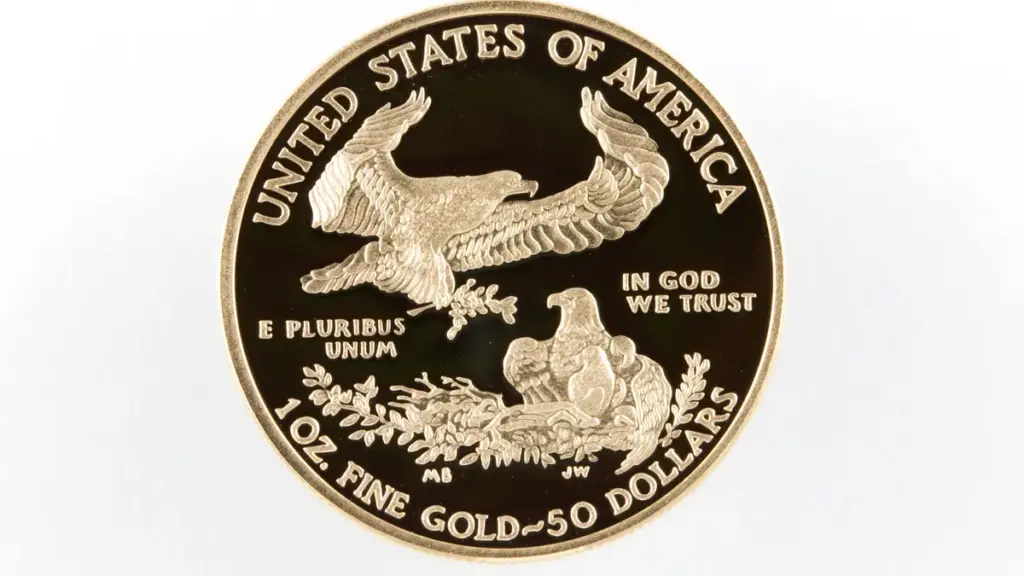
- from 1986 to 2021, the reverse showed a family of eagles at a nest, designed by Miley Tucker-Frost,
- since 2021, it shows a close-up of an eagle’s head, designed by Jennie Norris and sculpted by Renata Gordon,
- the Mint also refined the obverse in 2021, restoring details from Saint-Gaudens’ original model.
Both designs contain the same gold. For a bullion buyer, the older “family of eagles” coins and the new “eagle head” coins are worth the same, and dealers often sell them as “random year.”
The American Silver Eagle
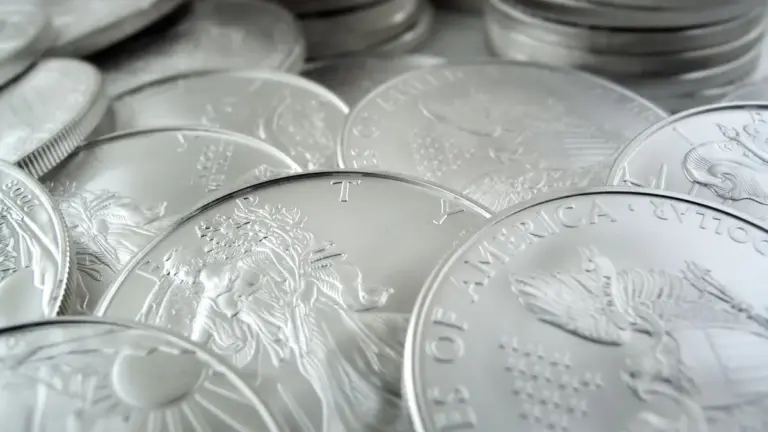
The Silver Eagle is the best-known silver coin in the US. It is made in one bullion size: 1 troy ounce of 99.9% fine silver, with a face value of one dollar.
The obverse is the Walking Liberty design, based on Adolph A. Weinman’s 1916 half dollar. Since 2021, the reverse shows an eagle coming in to land with an oak branch in its talons, designed by Emily Damstra and sculpted by Michael Gaudioso. The coin carries the words “1 OZ. FINE SILVER” and “ONE DOLLAR.”
Is the Silver Eagle a good way to buy silver? It is a trusted one, but rarely the cheapest. Silver coins carry much higher premiums than gold coins, because minting and shipping costs are large compared with the value of one ounce of silver. Our guide to silver bars vs coins shows how big that gap can be.
How much is a Silver Eagle worth?
A bullion Silver Eagle is worth its silver plus a dealer premium. On November 2, 2026, the silver inside was worth $50.56 at spot. Here is what four US dealers asked:
| Dealer | Coin | Price | Premium over spot |
|---|---|---|---|
| Summit Metals | 1 oz Silver Eagle | $56.50 | 11.75% |
| Hero Bullion | 1 oz Silver Eagle | $57.32 | 13.37% |
| Gainesville Coins | 2020 1 oz Silver Eagle | $63.62 | 25.83% |
| SD Bullion | 2024 1 oz Silver Eagle | $69.75 (plus $9.95 shipping) | 37.95% |
Notice the pattern? In our data, the two coins sold with a set year were the most expensive. If you only want the silver, a coin without a set year does the same job for less. Check today’s offers on our page of the cheapest silver coins.
The American Platinum and Palladium Eagles
The Platinum Eagle was authorized by Congress in 1996 and first sold in 1997. The bullion coin holds 1 troy ounce of 99.95% platinum. The Palladium Eagle followed in 2017 under a law passed in 2010, with a face value of $25. According to the Mint’s 2017 annual report, it sold its first 15,000 bullion Palladium Eagles on the first day of release.
Neither coin is made every year, and both trade in smaller volumes than gold and silver Eagles. That shows in the price:
- Summit Metals: $1,625.72 for a 1 oz Platinum Eagle, 12.58% over spot,
- Gainesville Coins: $1,638.00, 13.43% over spot,
- SD Bullion: $1,748.29, 21.07% over spot.
These premiums are calculated against the daily platinum spot value of $1,444.00 on November 2, 2026, from the Metals Radar price service. Our data had no US offers for the Palladium Eagle on that day. For a wider view of the metal, see our platinum price chart.
How Much Is a Gold Eagle Worth Today?
A Gold Eagle is worth its gold content at the spot price, plus a premium. The spot price is the market price for one troy ounce of gold. The premium is what the coin costs above that, and it covers minting, distribution and the dealer’s margin.
The formula is simple:
Premium % = (coin price − gold value at spot) / gold value at spot × 100
Here is what three US dealers charged for each size on November 2, 2026:
| Size | Gainesville Coins | Hero Bullion | Summit Metals | Lowest premium |
|---|---|---|---|---|
| 1 oz | $3,993.15 | $4,082.95 | $4,100.45 | 1.98% |
| 1/2 oz | $2,011.29 | $2,125.04 | $2,096.76 | 2.73% |
| 1/4 oz | $1,020.42 | $1,030.48 | $1,086.42 | 4.24% |
| 1/10 oz | $435.62 | no offer | $449.09 | 11.25% |
The chart makes the size effect easy to see:
What does that mean in dollars? Ten 1/10 oz coins from the cheapest dealer cost $4,356.20. One 1 oz coin cost $3,993.15. Same gold, $363.05 apart.
1 oz Gold Eagle
The 1 oz coin is the standard choice for investors. It has the lowest premium per ounce of the four sizes. On November 2, 2026, the cheapest offer was 1.98% over spot, while the most expensive was 4.72%.
1/2 oz and 1/4 oz Gold Eagles
These sizes suit buyers who want gold in smaller steps. The 1/2 oz coin started at 2.73% over spot, close to the 1 oz coin. The 1/4 oz coin started at 4.24%, but one dealer asked 10.98%, so shopping around matters more here.
1/10 oz Gold Eagle
The 1/10 oz coin is the cheapest way to own a Gold Eagle at all, at $435.62. It is popular as a gift. As an investment, though, it is the most expensive way to buy gold in the family, at 11.25% over spot or more.
Read also: Gold Premium Over Spot: What You Really Pay and Why
Gold Eagle vs Other 1 oz Gold Coins
The Gold Eagle is rarely the cheapest 1 oz gold coin. You pay a little extra for the name, the US government guarantee and how easy the coin is to sell in the United States. How much extra? Here are the lowest prices we found for popular 1 oz coins:
| 1 oz coin | Lowest price | Dealer | Premium over spot | Purity |
|---|---|---|---|---|
| South African Krugerrand | $3,943.47 | Gainesville Coins | 0.71% | 22 karat |
| American Buffalo | $3,964.03 | Hero Bullion | 1.23% | 24 karat |
| Canadian Maple Leaf | $3,982.47 | Gainesville Coins | 1.71% | 24 karat |
| British Britannia | $3,986.36 | Hero Bullion | 1.80% | 24 karat |
| American Gold Eagle | $3,993.15 | Gainesville Coins | 1.98% | 22 karat |
The spread between the cheapest and the dearest coin was $49.68 per ounce. That is small next to the $107.30 gap between dealers for the very same Gold Eagle.
Choose the Gold Eagle if:
- you want a coin that any US dealer or coin shop knows on sight,
- you plan to sell in the United States later,
- you like the 22 karat alloy for coins that get handled.
Choose the Buffalo, Krugerrand or Maple Leaf if:
- you want the lowest price per ounce on the day,
- you prefer 24 karat gold (Buffalo, Maple Leaf),
- you buy often and want to switch to whichever coin is cheapest.
Compare them on our American Buffalo gold coin prices page, or see our ranking of the best gold coins to buy.
Bullion, Proof and Burnished Eagles
Not every Eagle is a bullion coin. The US Mint also makes collector versions, and they cost a lot more. Here is how to tell them apart:
- Bullion: the standard coin sold through authorized purchasers and dealers, priced close to spot.
- Proof: struck several times with polished dies, so the fields look like a mirror. Carries a “W” mint mark for the West Point Mint and is sold by the US Mint in a box with a certificate.
- Burnished (uncirculated): a satin finish and a “W” mint mark, also sold directly by the US Mint to collectors.
Proof and burnished coins hold the same metal, but their price depends on collector demand, not only on spot. That makes them numismatic coins rather than bullion. If your goal is to own gold or silver at the lowest cost, stick to bullion Eagles.
How to Buy American Eagle Coins
Buying Eagles is simple once you know where the money goes. Follow these steps:
1. Check the spot price
Look at the live gold price chart before you shop. Without it, you cannot judge whether a premium is fair.
Gold has moved a lot in a year. On November 2, 2026, spot was $3,915.70, far below the January peak. Silver swung even harder: our data shows a high of $116.92 on January 29, 2026, against $50.56 on November 2.
2. Compare dealers, not only coins
The same coin can cost very different amounts. Compare the full price, including shipping and any card fee. Our list of bullion dealers and the page of cheapest gold coins help you do that in a few minutes.
3. Check sales tax in your state
Many US states exempt bullion from sales tax, but not all of them, and some apply limits. Our glossary entry on precious metals sales tax explains how it works.
4. Plan storage
Keep coins in their original tube or capsule and avoid touching the faces. Our guide on how to store gold covers home safes, bank boxes and vaults.
5. Learn to spot fakes
Popular coins attract counterfeits. Check the weight and diameter against the Mint’s specifications and buy from known dealers. We list the main checks in our guide to spotting a fake American Gold Eagle.
Are American Eagles Good for an IRA and How Are They Taxed?
Yes, American Eagles can go into a self-directed IRA, which is one reason they are so popular in the US. The IRS treats most coins in an IRA as collectibles, but it excludes certain gold, silver and platinum coins described in 31 USC Section 5112. That is the law under which the US Mint strikes American Eagles. The coins must be held by an approved custodian, not at home.
When you sell Eagles held outside a retirement account, the IRS taxes gains on physical gold and silver as collectibles. According to IRS Topic 409, long-term gains on collectibles can be taxed at up to 28%. Talk to a tax professional about your own situation.
Summary: American Eagle Coin
| Point | What you need to know |
|---|---|
| What it is | The official US bullion coin, struck by the US Mint since 1986 |
| Gold Eagle | 22 karat, 4 sizes, full fine gold weight; 1 oz from 1.98% over spot |
| Silver Eagle | 1 oz of 99.9% silver; from 11.75% over spot, year-specific coins cost more |
| Best value | The 1 oz Gold Eagle, bought random year from the cheapest dealer |
FAQ: American Eagle Coin
What is an American Eagle coin?
An American Eagle coin is the official bullion coin of the United States, struck by the US Mint. It is made in gold and silver since 1986, in platinum since 1997 and in palladium since 2017.
Are American Gold Eagles legal tender?
Yes, American Gold Eagles are US legal tender with face values of $50, $25, $10 and $5. Their market value is set by the gold they contain, which is many times higher.
Is a 1 oz Gold Eagle pure gold?
No, the Gold Eagle is 22 karat, or 91.67% gold mixed with silver and copper. It still contains one full troy ounce of fine gold, so the coin itself weighs 33.931 grams.
How much is a $50 Gold Eagle worth?
A $50 Gold Eagle is worth far more than its face value. On November 2, 2026, its gold was worth $3,915.70, and the cheapest US dealer price was $3,993.15.
How much is a $5 Gold American Eagle worth?
The $5 Gold Eagle is the 1/10 oz coin. On November 2, 2026, it held $391.57 of gold at spot, and the cheapest US dealer price in our data was $435.62.
How much does a Silver Eagle weigh?
A Silver Eagle contains one troy ounce of 99.9% fine silver, which is 31.10 grams. That is about 1.1 ounces on a kitchen scale.
Where can you buy American Eagle coins?
You can buy bullion Eagles from US bullion dealers and coin shops, not from the US Mint directly. The Mint sells bullion coins only to authorized purchasers, who supply the dealers.
Are American Eagles better than Buffalos?
Not always, it depends on what you want. The Eagle is 22 karat and the Buffalo is 24 karat; on November 2, 2026, the cheapest 1 oz Buffalo cost $29.12 less than the cheapest 1 oz Gold Eagle.
Compare American Eagle Prices Before You Buy
The gold inside every 1 oz Eagle is the same, but the price is not. On one morning, the same coin cost $107.30 more at one dealer than at another, and the dearest Silver Eagle in our data cost $13.25 more than the cheapest one, before shipping.
Metals Radar compares prices from US bullion dealers and does not sell metal. Start with the Gold Eagle and Silver Eagle price pages linked at the top of this guide, or browse all gold coin prices to compare the Eagle with other coins.
This article is for informational purposes only and is not investment or tax advice.
Was this article helpful?
Thanks for your feedback!